If you’ve ever tried to use a scissor lift on lumpy, sloped ground, you know it’s not just a hassle—it’s straight-up dangerous. As someone who’s been supplying scissor lifts for over a decade, I’ve seen too many folks cut corners here: skipping pre-checks, eyeballing the ground, and then panicking when the lift starts teetering mid-job. Let me break this down like I would to a regular contractor or weekend renter, no fancy jargon, just what actually works. Scissor Lift
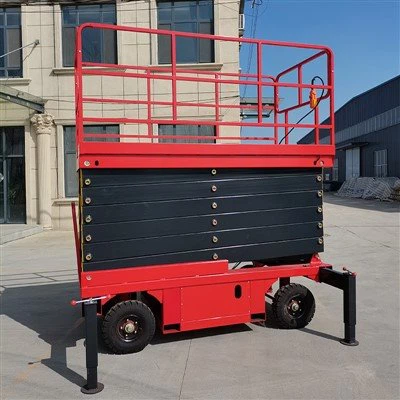
First off, let’s get one thing straight: scissor lifts aren’t built to work on uneven ground. The manuals (mine included) will tell you that a lot of them max out at a 5-degree slope for driving, and zero for operating. Yeah, some heavy-duty industrial models can stretch that to 8 degrees, but that’s for moving, not lifting a crew up to rehang lights. Push past that, and you’re risking the lift tipping, hydraulic lines blowing, or someone taking a hard fall. I’ve had a customer a couple years back who thought “close enough” was fine; he ended up with a bent scissor arm and a $12k repair bill, plus he couldn’t run his job for a week. Don’t be that guy.
Now, let’s walk through the steps I tell every new customer, and the tricks that actually save time.
First, do a quick ground scan before you even wheel the lift in. Grab a 4-foot level (or even a phone level app—they’re pretty accurate) and walk the perimeter of the work area. If you see big dips, ruts from heavy trucks, or slopes steeper than the side of a mild hill, you might need to adjust the ground, not just the lift. Wait, adjust the ground? Yeah, not every site is perfectly smooth. For small dips, you can use aluminum ground mats (we sell these as add-ons for exactly this) or compacted gravel. For bigger slopes, sometimes you can level the area with a plate compactor, or build a temporary wooden platform that’s framed tight and set on compacted dirt. Pro tip: never use cinder blocks or loose bricks as shims. I’ve seen them crack under the weight of the lift, which is way worse than even a small unlevel spot.
Once the ground is as even as it’s gonna get, it’s time to set the lift. Here’s where a lot of people mess up: they don’t put the lift in the right spot first. Scissor lifts have a center of gravity—usually right around the middle of the base. So park the lift so its base is as square as possible to the low spot. Let’s say one side of the ground is 2 inches lower than the other: park the lift so the low side of the ground is under the lift’s low base leg, not the high one. That might seem backwards, but it lines up the center of gravity so you don’t have to crank one side of the lift super high.
Now, use the lift’s own leveling system. Most modern scissor lifts have automatic level sensors—little green lights that turn off when it’s stable, or error codes if you’re off. But if you’ve got an older model, it’s manual, so you’ll need to use the adjustable outriggers (those fold-down legs that stick out from the base). Here’s how to do it right: lower the lift all the way to the ground first. Don’t try to level it when it’s elevated— that’s a one-way ticket to a tip. Then, unfold all four outriggers (even if it looks like you only need two—trust me, all four distribute weight evenly). For each outrigger, use the built-in extension pins to adjust the height. Again, check the level: stick the level on the lift’s base, not on the ground itself. The ground might be lumpy, but the level needs to be on the lift’s solid steel frame.
Wait, what about when the ground is really uneven, like a concrete slab that’s got a 3-inch slope across it? You can’t level that with outriggers alone. For that, we recommend custom steel shims—we’ve got different thicknesses, like 1/2 inch, 1 inch, 2 inches, that you slide under the outrigger legs. Never use wood shims that are thinner than 1 inch—they’ll compress, and you’ll end up with an unlevel lift mid-job. Also, make sure the shims are centered under the outrigger so the weight doesn’t push them out. I once watched a shim slip because it was only half under the leg, and the lift shifted so fast the operator had to jump. Scary stuff.
Once you think you’re level, test it. Don’t just get in the basket and go. Rock the base a little—if it shifts, you’re not level. Or, have a helper stand back and watch the lift’s frame: if one side tilts more than a degree, go back and adjust the outriggers. Another test: extend the lift 10 feet off the ground (not full height, that’s too much at once) and check the level again. A lot of people level it when it’s down, and when they raise it, the center of gravity shifts and throws it off. That’s why we tell customers to check after every major lift.
And here’s a big mistake I see renters make: they ignore the load capacity. Even if the lift is level, if you’ve got 3 people, a toolbox, and a bunch of materials in the basket, that changes the center of gravity. If the ground was already borderline, adding extra weight will push it over the edge. Always check the load rating—they’re printed on the lift’s frame, don’t guess. If you’re bringing more stuff up, spread it evenly: don’t put all the heavy tools on one side of the basket.
Wait, what if you’re on a really tight site, like a residential driveway that’s got a slight slope and you can’t add ground mats? For those, we have compact scissor lifts with narrower bases that have more precise leveling controls. I had a customer last month who needed to paint his garage ceiling, and his driveway sloped down 4 degrees toward the street. A standard lift wouldn’t fit his driveway width, but our narrow model has a digital level that beeps when it’s perfectly level, and automatic outriggers that adjust themselves in under a minute. That’s exactly the kind of fit we build into the lifts we supply—they’re not one-size-fits-all.
Another thing: weather plays a role. If it rained last night, the ground might be soft, so even if it looked hard yesterday, it could shift. Before you set up, push on the ground around the outriggers—if it sinks, you need to add a mat or a piece of plywood under each outrigger. Soft ground is just as bad as uneven ground, if not worse. I’ve seen a lift sink into mud a few inches, and it was impossible to level, so the job had to get delayed. Plan for that: check the ground conditions, don’t just roll the lift in and start.
Let me also address a myth I hear all the time: “I can level the lift by tilting the hydraulic rams while it’s elevated.” No, no, no. That’s super unsafe. When the lift is up, the hydraulic cylinders are holding the entire load, and forcing them to tilt will put way too much stress on them. That’s a quick way to rupture a hydraulic line, which will drop the basket fast. Always level the lift when it’s fully lowered, before you extend it. That’s a non-negotiable rule.
If you’re new to using scissor lifts, don’t be afraid to ask for help. I get calls all the time from guys who just bought a lift and are confused about the leveling controls. We offer free 15-minute walkthroughs for all our customers, whether you’re buying or renting. We can even come out to your site for bigger jobs to check the ground and make sure the lift is set up right. That’s the kind of service we pride ourselves on— not just selling a lift, but making sure you use it safely.
At the end of the day, leveling a scissor lift isn’t hard, but it is non-negotiable. Skipping this step isn’t just a safety risk—it can cost you money in repairs, downtime, or even legal fees if someone gets hurt. When you work with us, we don’t just hand you a lift and send you on your way. We make sure you have the tools you need, like ground mats and shims, and the know-how to use them right.

If you’re planning a job and need a scissor lift, or you have questions about leveling for your specific site, don’t hesitate to reach out. We’re here to help you pick the right lift, walk you through setup, and make sure your job goes smooth and safe.
Self Propelled Scissor Lift References
- Occupational Safety and Health Administration (OSHA). "Scissor Lift Safety Requirements." 2023.
- American National Standards Institute (ANSI). "Safe Use of Aerial Lifts." ANSI/SIA A92.6, 2022.
- Equipment Sales & Service Magazine. "Proper Ground Preparation for Scissor Lift Operation." 2021.
- Scissor Lift Manufacturer Association. "Operator Manual Guidelines for Uneven Ground Operation." 2022.
Shandong Zhongke Huali Machinery Co., Ltd.
As one of the most professional scissor lift manufacturers and suppliers in China, we also support customized service. We warmly welcome you to wholesale discount scissor lift in stock here from our factory. For price consultation, contact us.
Address: No. 2 Qubai Road, Qudi Street, Jiyang District, Jinan City, Shandong Province
E-mail: yonghuiai@hualizgjx.com
WebSite: https://www.hualiheavy.com/
